
Understanding Moisture — The Root Cause of Most Mold Problems
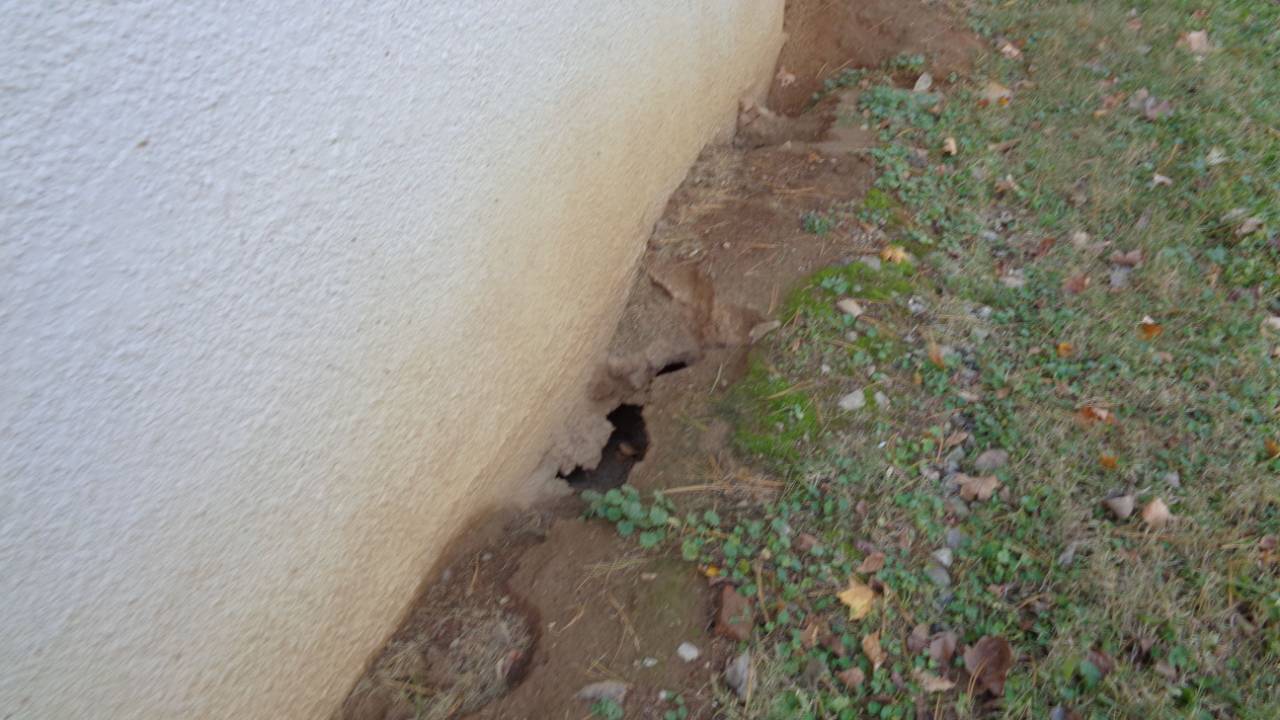
Soil that has pulled away from a foundation wall, a condition commonly associated with exterior water entry.
Disclosure: This post contains affiliate links. As an Amazon Associate I earn from qualifying purchases. If you choose to purchase through these links, I may earn a small commission at no additional cost to you. I only recommend products that align with what is generally used and recommended in the indoor air quality and moisture control field.
If you want to understand mold, start with moisture.
Moisture is generally considered the root of most mold problems in buildings. Not the mold spores — those are everywhere, indoors and outdoors, all the time. The variable that determines whether those spores become an active mold problem is moisture. Specifically: whether sufficient moisture is present, for a sufficient period of time, on a surface that supports mold growth.
Without sufficient moisture, mold growth is generally not supported.
Which means that mold prevention, at its core, is moisture management.
Where Moisture Comes From in Buildings
Moisture in buildings comes from three primary sources — and understanding all three is what gives building owners, property managers, and facility professionals a complete picture of their moisture risk.
Source 1 — Exterior water intrusion.
This is the most visible category: rain, groundwater, and snowmelt finding their way into the building through the roof, walls, foundation, or grading. Roof leaks, failed flashing, bulk water against a foundation, improperly graded soil that directs water toward the building — these are the most commonly recognized sources of moisture intrusion.
What is generally recognized by building science professionals: exterior water intrusion is rarely as simple as "water is getting in here." Water follows the path of least resistance through a building assembly, which means the point of entry and the point of visible damage are often in different locations. A roof leak may not show up until it has traveled down a rafter and into a wall cavity. A foundation moisture problem may not become apparent until flooring in a living space begins to show signs.
Source 2 — Plumbing and mechanical system leaks.
This category includes everything from active plumbing leaks to the slow, often undetected drips that are the most common cause of hidden mold growth in building cavities. A condensate drain that overflows intermittently. A supply line fitting that weeps slowly beneath a sink cabinet. A water heater that sweats in a poorly ventilated mechanical room.
These sources are significant because they deliver moisture directly to building materials — often over extended periods before the moisture becomes visible or causes obvious damage.
Source 3 — Humidity and condensation.
This is the category that is most often overlooked — and in many climates, the most significant contributor to mold risk in buildings.
Indoor humidity — from cooking, bathing, breathing, and even the off-gassing of building materials — accumulates in the air inside a building. When that humid air contacts a surface that is cooler than the dew point of the air, condensation forms on that surface. Over time, that condensation feeds mold growth.
In climates with high outdoor humidity, this dynamic can work in the reverse direction as well: warm, humid outdoor air infiltrating a cooled building interior can condense on cool surfaces within the building assembly — inside wall cavities, on ductwork, on the underside of roof sheathing.
How Moisture Moves Through a Building
One of the most important things building science professionals emphasize about moisture is that it moves.
Liquid water wicks through porous materials. Vapor migrates through assemblies driven by pressure and temperature differentials. And once moisture is in a building assembly — inside a wall, under a floor, in a ceiling cavity — it often stays there long after the source has been resolved.
This is why the location of visible mold is often not the location of the moisture source. It is where the moisture ended up. Finding the source — and understanding how it moved through the building — is what a professional moisture assessment is designed to do.
What Moisture Does to Building Materials
Not all building materials respond to moisture equally — but most of the materials that make up typical residential and commercial construction are capable of supporting mold growth when they remain damp.
Wood framing and structural members. Drywall paper facing. Insulation batts. Ceiling tiles. Subfloor materials over concrete slabs. All of these are materials that, when maintained in a damp state for as little as 24 to 72 hours, create conditions generally associated with mold growth.
What is generally recognized by building science and IAQ professionals: addressing the moisture source is a separate — and equally important — step from addressing any mold growth that has already developed. Remediating visible mold without correcting the underlying moisture source is generally understood to be a temporary solution.
What Is Generally Recommended for Moisture Management
Building science and IAQ professionals generally recommend several practices as the foundation of moisture management in any building:
Monitor relative humidity. Indoor relative humidity between 30 and 50 percent is the range generally associated with inhibiting mold growth. Inexpensive humidity monitors — hygrometers — are generally considered useful tools for any building occupant or manager.
Address moisture intrusion promptly. When water enters a building — from any source — the general recommendation is that affected materials should be dried within 24 to 48 hours. After that window, conditions generally become favorable for mold growth.
Maintain mechanical systems. HVAC systems that manage humidity — through cooling, dehumidification, or ventilation — are generally considered critical components of a building's moisture management system. Regular maintenance, including condensate system checks and filter changes, is generally recommended.
Ensure adequate ventilation. Bathrooms, kitchens, laundry rooms, and crawl spaces are the highest-moisture areas in most buildings. Ventilation systems that exhaust moisture-laden air to the exterior — not into attic spaces or wall cavities — are a general best practice in building science.
Tools Commonly Referenced for Moisture Monitoring and Control
The following are among the tools most commonly referenced for monitoring and controlling humidity and moisture conditions. These are affiliate links — see the disclosure at the top of this post. The right equipment depends on the size and condition of the space, and a qualified professional can help assess it.
- Thermo-Hygrometer — commonly used to monitor temperature and relative humidity
- Digital Moisture Meter (General Tools) — commonly referenced for checking moisture content in wood and building materials
- Portable Dehumidifiers (Amazon) — a wide selection of residential units, commonly referenced for basements and living areas
- Alorair Commercial-Grade Dehumidifiers — commonly referenced in professional crawl space, restoration, and larger-structure applications
Moisture Is Where the Story Starts
Most mold problems are moisture stories. Knowing where moisture comes from, how it moves, and what it does to building materials is what makes it possible to recognize risk before mold develops — and to understand what needs to happen when it does.
Want to Learn More?
The free Mold Awareness Guide is a great starting point for understanding mold and moisture in your home. It is free and available to download.
Grab the Free Mold Awareness Guide
For deeper educational content on IAQ, mold, and moisture, visit the Mold Junkies YouTube channel.
This content is provided for general educational and awareness purposes only. It does not constitute inspection, environmental consulting, remediation, or professional advice of any kind. Conditions in buildings vary significantly. A qualified professional should be consulted regarding any specific building concern.